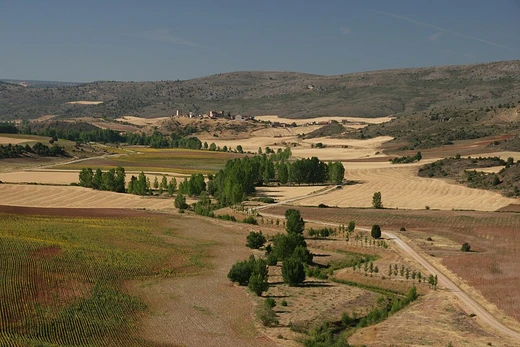
Patagonian Desert
Largest desert in Argentina, formed by Andean rain shadow.

Located primarily in Argentina, it is bounded by the Andes to the west and the Atlantic Ocean to the east, extending into southern Argentina and parts of Chile. It is a cold winter desert that has existed since the Middle Miocene, formed as the Andes rose and created a rain shadow that blocks moisture from the Pacific.
- location
- Primarily Argentina, with areas in Chile
- type
- Cold winter desert
- formation
- Middle Miocene (14–12 million years ago)
- average_temperature
- 3 °C
- largest_desert_south_of_40th_parallel
- True
- primary_land_uses
- Cattle, sheep, and horse husbandry
Lore & Background
The Patagonian Desert has been inhabited by hunter-gatherers since Pre-Hispanic times, with the Tehuelche complex being the earliest known inhabitants. In the 18th and 19th centuries, the northern part came under Mapuche influence during a process of Araucanization, and Mapuches practiced horse husbandry and controlled trade across the desert. The 19th century saw migration of Argentines, Welsh, and other European peoples, transforming the region from a conflictive borderland into an integral part of Argentina.
Reader's Guide
The Patagonian Desert is significant as a vast cold desert shaped by the Andes' rain shadow and the cold Falkland Current. Its harsh climate, with temperatures rarely exceeding 12 °C and strong westerly winds, supports a unique ecosystem of shrubby and herbaceous plants, tuft grasses, and animals such as the guanaco, puma, and lesser rhea. Today, the area is sparsely populated, with livestock raising and resource mining (oil, gas, coal) as primary human activities. Protected areas cover 12% of the ecoregion, preserving its unique landscapes and biodiversity.
Did You Know?
- The Patagonian Desert is the largest desert south of the 40° parallel.
- The desert's formation is due to the Andes creating a rain shadow that blocks Pacific moisture.
- The lowest recorded temperature in the region is -32.8 °C (Sarmiento, Chubut), though other low values exist; the figure -33.9 °C is not a verified official record for the desert.
Naming, Scale, and Physical Character
The Gobi derives its name from the Mongolian word Gov', a term Mongolians apply broadly to every waterless stretch across their plateau. When the name crossed into Chinese as gēbì, it acquired a narrower meaning, pointing specifically to rocky, semi-arid terrain rather than the rolling sand seas people typically picture when they hear 'desert.' That distinction matters, because much of the Gobi is not sandy at all; instead it presents as exposed bare rock stretching across an immense area. Its boundaries stretch from the Pamir foothills in the west all the way to the Greater Khingan range near Manchuria in the east, and from the Altay, Sayan, and Yablonoi ranges in the north down to the Kunlun, Altyn-Tagh, and Qilian ranges that mark the northern rim of the Tibetan Plateau.
A Cold Desert Defined by Violent Swings
Far from the scorching heat most deserts are known for, the Gobi is fundamentally a cold environment. Temperatures can plunge to minus 40 degrees Celsius in winter yet climb to 45 degrees in summer, and a single 24-hour span has recorded swings of as much as 35 degrees. In southern Mongolia, readings have dipped to minus 32.8 degrees, while in Alxa, Inner Mongolia, July highs have reached 37 degrees. The Siberian anticyclone, strongest during winter, locks the region into extreme dryness, and the result is a landscape punctuated by icy dust storms and snow squalls in early January and again in spring and early summer.
Fossil Treasures and a Living Fauna
The Gobi has long been a magnet for paleontologists. Beyond its deep past, the desert sustains a surprising array of wildlife. Endemic or near-endemic residents include black-tailed gazelles, marbled polecats, wild Bactrian camels, Mongolian wild asses, and sandplovers, while snow leopards, Gobi bears, and wolves make occasional appearances. Lizards are particularly well adapted to the conditions, with around thirty species distributed along the southern Mongolian border. The dominant vegetation consists of drought-tolerant shrubs such as gray sparrow's saltwort and gray sagebrush, alongside low grasses like needle grass and bridlegrass, though livestock grazing has steadily reduced their cover. Protected areas including Gobi Gurvansaikhan National Park and the Great Gobi A and B Strictly Protected Areas now help safeguard this fragile ecosystem.
An Expanding Frontier and the Fight to Hold It
The northern and eastern desert-grassland boundaries shift constantly, influenced by pre-growing-season climate conditions that govern evapotranspiration and plant establishment. Drivers of the expansion include deforestation, overgrazing, water-resource depletion, and broader climate change. In Mongolia, nomadic herders raising goats for cashmere wool have degraded grasslands, while off-road vehicles and livestock trampling compound the damage, especially in the wetter eastern Gobi where some livestock can still be sustained.
Frequently Asked Questions
What is the Patagonian Desert?
The Patagonian Desert, often called the Patagonian Steppe, is a cold winter desert stretching across southern Argentina and parts of Chile. It holds the title of Argentina's largest desert and ranks as the eighth-largest desert on Earth by total area.
How was the Patagonian Desert formed?
The desert began taking shape during the Middle Miocene, roughly 14 to 12 million years ago, as the Andes mountain range rose. The growing mountains created a rain shadow that blocks Pacific moisture, leaving the eastern side dry.
What is the climate like in the Patagonian Desert?
It is classified as a cold winter desert with an average temperature around 3 °C (37 °F). Despite its arid conditions, it is far from a hot, sandy landscape—winds and cold are its defining features.
Where exactly is the Patagonian Desert located?
It sits in the southern portion of South America, bounded by the Andes to the west and the Atlantic Ocean to the east. Most of its territory falls within Argentina, though it extends into parts of Chile.
More in Deserts And Drylands 25-28
Elsewhere in the Deserts And Drylands universe
Spotted an error? Know more?
This is a living reference — every entry is fact-audited, and reader corrections feed straight into our audit queue. Suggest an edit · See this site's audit record