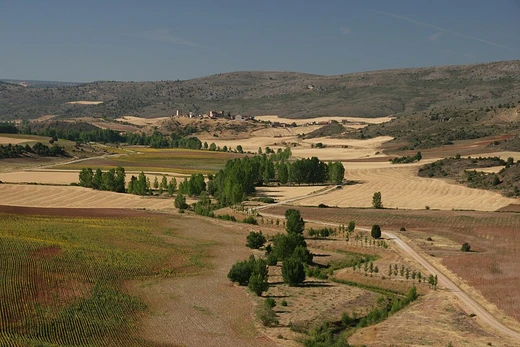
Syrian desert
A vast West Asian desert, home to ancient trade routes and nomadic tribes.

It includes parts of northern Saudi Arabia, eastern Jordan, southern Syria, and western Iraq, accounting for about 75-80% of Jordan's land area and 55% of Syria's. Historically inhabited by nomadic Arabs and Aramean tribes, the desert contains important ancient settlements such as Palmyra and Dura-Europos, and its strategic location has made it a crossroads for trade and conflict.
- Percentage of Jordan
- 75-80%
- Highest peak
- Jabal al-‘Arab (or Jabal al-Druze)
Lore & Background
The Syrian desert was historically inhabited by nomadic Arabs (Bedouins) and nomadic Aramean tribes, with many tribes still living in towns and settlements near oases. Safaitic inscriptions, proto-Arabic texts written by literate Bedouin, date roughly from the first century BC to the fourth century AD. One of the most important ancient settlements is Palmyra, first mentioned in the second millennium BC, which became a key trading center in Roman times by taxing caravans on the Silk Road. Another settlement, Dura-Europos on the Euphrates, was founded as a fortress during the Seleucid Empire and prospered due to its location fostering connections between Mesopotamia and the Mediterranean, but was abandoned after being raided by the Sasanian emperor Shapur I in the 250s.
Reader's Guide
The Syrian desert's significance lies in its role as a historical crossroads for trade, migration, and conflict. Its location on the Silk Road allowed Palmyra to become a wealthy trading center, while its arid expanse has served as a refuge and route for nomadic peoples and, in modern times, for insurgent groups. During the Ottoman Empire's Armenian genocide, large numbers of victims were deported across the Euphrates into the desert to die. The desert's ecosystem is under threat from drought, over-grazing, and hunting, but rehabilitation projects have shown success in restoring degraded land. The desert is also the origin of the golden hamster.
Did You Know?
- The Syrian desert is the origin of the golden hamster.
- Safaitic inscriptions, proto-Arabic texts written by literate Bedouin, are found throughout the Syrian Desert and date roughly from the first century BC to the fourth century AD.
Frequently Asked Questions
What are Syrian desert's powers/role?
The desert has functioned for millennia as a natural corridor linking the Mediterranean coast to the Arabian interior, channeling trade caravans, migrating herds, and armies. Its open steppe supported nomadic Arab and Aramean tribes who moved flocks across the landscape seasonally.
How does Syrian desert's story end?
There is no narrative conclusion; the desert simply endures as a living terrain that still occupies about 75–80% of Jordan's land and 55% of Syria's. Ancient cities such as Palmyra and Dura-Europos sit along its margins as silent witnesses to the civilizations that once flourished there.
Why is Syrian desert important?
Its geographic position made it a strategic crossroads for commerce, migration, and warfare from antiquity onward. The region also preserves some of West Asia's most significant archaeological sites, underscoring its role as a cradle of settled life amid an otherwise harsh environment.
What is Syrian desert's highest peak?
The tallest elevation in the region is Jabal al-ʿArab, also called Jabal al-Druze, which rises in the southwestern portion of the desert.
More in Deserts And Drylands 25-28
Elsewhere in the Deserts And Drylands universe
Spotted an error? Know more?
This is a living reference — every entry is fact-audited, and reader corrections feed straight into our audit queue. Suggest an edit · See this site's audit record