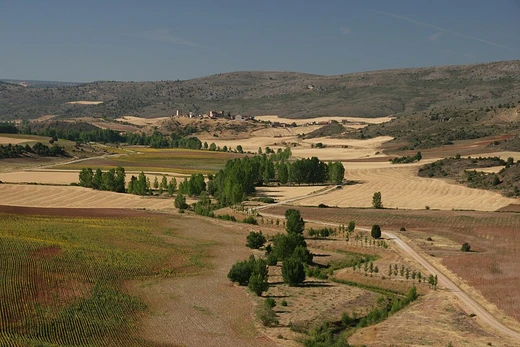
Chihuahuan Desert
Largest hot desert in North America, highly biodiverse.

The Chihuahuan Desert is a desert ecoregion covering parts of northern Mexico and the southwestern United States.
- Age
- Formed around the Pleistocene-Holocene transition, approximately 11,700 years ago, with current arid conditions developing over the last 10,000–12,000 years
Lore & Background
The desert's flora is dominated by creosote bush on valley soils, with yucca and numerous Opuntia species on slopes. Trees are less common than in nearby mountainous regions, but species such as desert willow, honey mesquite, and netleaf hackberry occur in arroyos. Desert grasslands comprise 20% of the desert, including grasses like blue grama and black grama. The region has been badly degraded mainly due to grazing, leading to dominance of woody native plants such as creosote bush and mesquite.
Reader's Guide
The desert faces threats from overgrazing and urbanization, which have altered its plant communities. The Mexican wolf, once abundant, was nearly extinct and remains on the endangered species list.
Did You Know?
- The World Wide Fund for Nature considers it the most biologically diverse desert in the world, measured by species richness or endemism.
- Desert grasslands comprise 20% of the Chihuahuan Desert, including grasses like blue grama and black grama.
- Protected areas cover about 7% of the ecoregion, including Carlsbad Caverns National Park, Janos Biosphere Reserve, and Cuatro Ciénegas Basin.
Geological Sculpting and Eolian Processes
Deserts are not static wastelands but dynamic landscapes continuously reshaped by physical forces. The primary sculptor is temperature: the extreme swings between scorching daytime heat and cool nights strain rock surfaces until they fracture into smaller fragments. When rare but intense downpours strike these hot surfaces, the thermal shock can shatter stone entirely, scattering rubble across the ground. From there, wind takes over as the dominant agent of erosion. It lifts fine sand and dust into the atmosphere, where particles can linger for extended periods and occasionally coalesce into sweeping sand or dust storms. As wind-blown grains strike solid objects, they abrade surfaces, smoothing rock over time. The wind also sorts sediment by size, depositing fine grains as flat sheets or piling them into billowing dunes. In other locations, all the fine material is stripped away, leaving a mosaic of smooth stones known as desert pavements, where further erosion is minimal. Rock outcrops, exposed bedrock, and clay deposits from ancient water flow add further textural variety to these arid landscapes.
Life in Extreme Aridity
Survival in a desert demands extraordinary biological ingenuity. Vegetation in these regions tends toward toughness and wiriness, with leaves reduced to minimal size or eliminated entirely. A water-resistant cuticle coats the surface, and many species develop spines as a deterrent against herbivores. The life-cycle strategies vary dramatically: some annuals seize the brief window after a rainfall to germinate, flower, and complete their entire reproductive cycle within mere weeks before dying. In contrast, long-lived perennials invest in deep root systems that reach underground moisture sources, allowing them to persist through years of drought. Animal life faces the twin challenges of thermoregulation and resource scarcity. Many species have shifted their activity to nighttime hours, retreating to shade or burrows during the punishing daytime heat. They have evolved remarkable efficiency in water conservation, extracting the majority of their hydration needs directly from food and producing highly concentrated urine. Some organisms take an even more extreme approach, entering prolonged dormancy. When the rare rainfall finally arrives, they emerge, reproduce rapidly while conditions permit, and then return to their dormant state.
Human Endeavor Across Arid Lands
For thousands of years, human communities have navigated the challenges of arid and semi-arid environments. Nomadic peoples developed a mobile lifestyle, moving flocks and herds to follow the scattered availability of grazing. Where underground aquifers surface as springs or seepages, oases emerge, offering the possibility of sedentary settlement. Trade routes have long threaded across vast deserts, most famously the Sahara, where caravans of camels carried salt, gold, ivory, and other valuable goods between distant markets. Tragically, these same routes also facilitated the northward transport of enslaved people. Agriculture in desert regions is possible but demands external water input; the Imperial Valley in California stands as a notable example of previously barren terrain transformed into productive farmland through imported irrigation. However, the cultivation of semi-arid zones without adequate safeguards accelerates soil erosion and contributes to the broader process of desertification. Beyond agriculture, deserts offer other resources: mineral extraction occurs in some arid regions, and the uninterrupted sunlight presents significant potential for capturing large quantities of solar energy for human use.
Naming, Classification, and Global Significance
The very word desert carries a history that complicates its modern usage. English and its Romance-language relatives, including Italian and Portuguese deserto, French désert, and Spanish desierto, all trace back to the ecclesiastical Latin dēsertum, a participle of dēserere meaning to abandon. Originally the term simply denoted an unpopulated place, with no necessary implication of aridity. Shakespeare's deserts of Bohemia and the old phrase Great American Desert focused on sparse human presence rather than climate. It was only in the twentieth century that the climate-science definition of low precipitation became dominant. Today, deserts are formally classified by annual rainfall, generally below 250 millimeters, by prevailing temperature, by the mechanisms driving their formation, or by geographic position. Roughly one-third of Earth's land surface falls into arid or semi-arid categories, a figure that includes polar regions where snow is the primary precipitation. Antarctica, with its vast ice sheet and the nearly snow-free Dry Valleys, represents the planet's largest cold desert. Both hot and cold deserts contribute to moderating global temperature because their high albedo reflects a greater proportion of incoming solar radiation than forests or ocean surfaces do.
Frequently Asked Questions
Who is Chihuahuan Desert?
Chihuahuan Desert is a desert ecoregion that stretches across northern Mexico and the southwestern United States, encompassing Far West Texas, the middle-to-lower Rio Grande Valley and lower Pecos Valley in New Mexico, a slice of southeastern Arizona, and the central and northern Mexican Plateau. It spans roughly 501,896 km², making it the largest hot desert on the North American continent.
What are Chihuahuan Desert's powers or role?
Its standout 'ability' is unmatched biological richness: the World Wide Fund for Nature ranks it as the most biodiverse desert on Earth when measured by species richness and endemism. It also serves as a critical ecological bridge between North American and Mexican flora and fauna.
How does Chihuahuan Desert's story end?
Because it is a living landscape rather than a finished narrative, there is no fixed ending; the arid regime that defines it has been intensifying over the past 10,000–12,000 years and continues to evolve with ongoing climate shifts. Fans of the ecoregion follow its changing species distributions and conservation status as the 'ongoing plot.'
Why is Chihuahuan Desert important?
It is the largest hot desert in North America and, per WWF assessments, the most species-rich desert worldwide, which makes it a top global conservation priority. Its cross-border extent also means it shapes regional water cycles, agriculture, and cultural identity for communities in both the U.S. and Mexico.
When was Chihuahuan Desert formed?
The ecoregion crystallized around the Pleistocene-to-Holocene transition, approximately 11,700 years ago, as post-glacial drying locked in the arid conditions that characterize the region today.
More in Deserts And Drylands 1-24
Related in Deserts And Drylands
Links follow this subject's own source article.
Elsewhere in the Deserts And Drylands universe
Spotted an error? Know more?
This is a living reference — every entry is fact-audited, and reader corrections feed straight into our audit queue. Suggest an edit · See this site's audit record