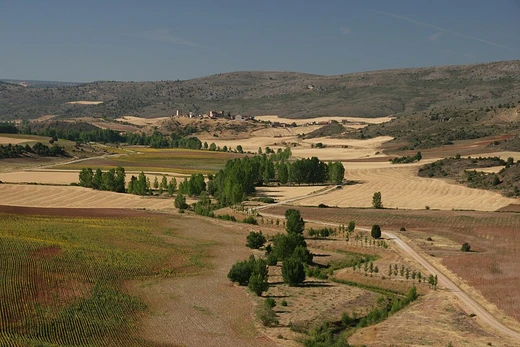
Mojave Desert
Smallest and driest of the four North American deserts.

Named after the indigenous Mohave people, it is located primarily in southeastern California and southwestern Nevada, with small portions extending into Arizona and Utah. It is the smallest and driest of the four North American deserts and is often colloquially called the 'high desert.'
- location
- Southeastern California and southwestern Nevada, with small portions in Arizona
- lowest_point
- Badwater Basin, the lowest point in North America
- major_cities
- Las Vegas, Lancaster-Palmdale, Victorville, St. George
- notable_features
- Joshua tree, Mojave River, Amargosa River, Devils Playground
Lore & Background
The Mojave Desert displays typical basin and range topography, with a series of parallel mountain ranges and valleys. The boundaries to the east are less distinctive due to the absence of an indicator species like the Joshua tree, which is endemic to the Mojave. Alluvial fans called bajadas form around mountains, extending down to low-altitude basins containing dried lake beds called playas, such as Rogers Dry Lake and China Lake.
Reader's Guide
The Mojave Desert supports a diversity of flora and fauna and hosts human activities including recreation, ranching, and military training. It contains deposits of silver, tungsten, iron, and gold. Invasive annual plants have facilitated fires in recent decades, altering many areas.
Did You Know?
- The Mojave Desert is the smallest and driest of the four North American deserts.
- The Joshua tree is endemic to the Mojave Desert and serves as an indicator species for its boundaries.
- The Devils Playground, within the Mojave National Preserve, consists of about 40 miles of dunes and salt flats.
- The Mojave Desert contains Rogers Dry Lake, used by the United States Air Force as runways for aircraft and the Space Shuttle.
Shaped by Stone, Wind, and Rare Water
The landscape of a desert is sculpted by relentless physical forces acting over vast stretches of time. Daily swings between scorching daylight and cool night air put enormous stress on exposed rock, causing it to fracture and crumble into smaller fragments. When the infrequent but violent downpours do arrive, rain striking superheated stone can shatter it further, scattering rubble across the ground. From there, the wind takes over as the dominant sculptor, lifting fine particles of sand and dust into the air where they can linger for extended periods, occasionally building into towering storms. As wind-blown grains strike any solid surface in their path, they slowly grind and smooth it down, while simultaneously sorting loose sand into either flat, level sheets or into the sweeping billows of dunes. In other areas, the wind strips away all fine material, leaving behind a mosaic of polished stones known as desert pavements where little further erosion takes place. Rock outcrops, exposed bedrock, and clay deposits from ancient water flow punctuate these surfaces, and where water briefly pools and then evaporates, salt pans and temporary lakes mark the cycle. Underground aquifers and springs, where they surface, create rare oases amid the aridity.
Life That Learns to Endure
Survival in an environment where rainfall is scarce and temperatures swing dramatically demands extraordinary biological ingenuity. The plants that manage to take root here tend to be tough and wiry, often sporting small or entirely absent leaves, water-resistant outer coatings on their surfaces, and sharp spines that discourage any herbivore from taking a bite. Among them, some annual species live lightning-fast lives—germinating, flowering, and dying within a matter of weeks after a rare shower—while other, more patient species persist for years, sending deep root systems far below the surface to tap into hidden underground moisture. The animal community faces its own set of challenges: staying cool, securing enough food, and conserving every drop of water. Many species have shifted their activity to the night, retreating into shade or burrowing underground to escape the punishing daytime heat. Their bodies are finely tuned to extract as much moisture as possible from whatever food they consume, and they concentrate their waste to minimize water loss. Some animals go further still, entering prolonged dormancy for extended stretches, only to snap back into furious activity when the infrequent rains arrive, reproducing rapidly while conditions briefly favor life before slipping back into their dormant state.
People, Routes, and the Taming of Barren Ground
For thousands of years, human communities have pressed against the edges of arid land, adapting their ways of life to the scarcity of water and the thinness of soil. Nomadic groups have traditionally moved their flocks and herds from patch to patch, following whatever sparse grazing the season offered, while the rare oases have anchored more permanent settlements where people could put down roots. The attempt to cultivate semi-arid regions, however, carries a hidden cost: it accelerates soil erosion and is recognized as one driver of the broader process of desertification. Where water can be imported from an outside source, the picture changes dramatically—the Imperial Valley in California stands as a striking example of how previously barren terrain can be coaxed into agricultural productivity through irrigation. Deserts have also served as corridors rather than barriers: long trade routes, particularly across the Sahara, were traversed by camel caravans hauling salt, gold, ivory, and other valuable goods, and tragically, large numbers of enslaved people were also carried northward along those same paths. Today, the uninterrupted sunlight that bathes these regions offers enormous potential for capturing solar energy on a large scale, and some mineral extraction also takes place within desert landscapes.
A Word, a Threshold, and a Global Role
The very word we use to name these landscapes carries a history that extends well beyond climate science. English "desert" and its relatives in Italian, Portuguese, French, and Spanish all trace back to the ecclesiastical Latin dēsertum, a participle of dēserere meaning "to abandon." For centuries, the term in English simply denoted an unpopulated area, with no necessary implication of dryness—Shakespeare's "deserts of Bohemia" and the old phrase "Great American Desert" spoke to sparse human presence rather than sandy aridity. It was not until the twentieth century that the word settled into its modern, climate-science meaning of a region receiving low precipitation. In that technical sense, a desert is defined by receiving less than two hundred and fifty millimeters of rain per year, while semi-deserts or steppes fall between two hundred and fifty and five hundred millimeters. Deserts occupy roughly one-third of the planet's land surface, a figure that includes polar regions where snow replaces rain. Both hot and cold deserts play a quiet but important role in regulating Earth's temperature: their high albedo means they reflect a greater share of incoming sunlight than forests or oceans do, nudging the global thermal balance.
Frequently Asked Questions
Who is Mojave Desert?
Mojave Desert is a high-desert region in the Southwestern United States, named in honor of the indigenous Mohave people. It occupies territory primarily in southeastern California and southwestern Nevada, with smaller stretches reaching into Arizona and Utah.
What are Mojave Desert's powers/role?
As the smallest and driest of the four major North American deserts, Mojave Desert sits in the rain shadow of the Sierra Nevada and Transverse Ranges, limiting annual rainfall to just 2 to 6 inches. Its elevation typically falls between 2,000 and 4,000 feet, earning it the nickname 'high desert.'
Where does Mojave Desert live?
Mojave Desert covers roughly 54,000 square miles across southeastern California, southwestern Nevada, and small portions of Arizona and Utah. Major cities within its territory include Las Vegas, Lancaster-Palmdale, Victorville, and St. George.
What is Mojave Desert's lowest point?
Badwater Basin, found within Mojave Desert's boundaries, is the lowest point in all of North America. This creates a striking contrast with the desert's usual elevation band of 2,000 to 4,000 feet.
Why is Mojave Desert important?
Mojave Desert holds a unique ecological niche as the driest and most compact of the continent's four deserts, supporting specialized plant and animal communities adapted to extreme aridity. It also anchors major population centers like Las Vegas and the Lancaster-Palmdale metro area, making it a critical region for both conservation and human settlement.
More in Deserts And Drylands 1-24
Related in Deserts And Drylands
Links follow this subject's own source article.
Elsewhere in the Deserts And Drylands universe
Spotted an error? Know more?
This is a living reference — every entry is fact-audited, and reader corrections feed straight into our audit queue. Suggest an edit · See this site's audit record